Table of Contents
Ever hit that mid-morning slump where the mere thought of waiting for coffee feels like an eternity? You’re not alone. In our fast-paced world, the quest for a genuinely quick caffeine fix often leads us straight to the humble blade grinder. Promising speed with the simple whirl of a blade, these compact countertop companions seem like the perfect solution for rushed mornings or spontaneous coffee cravings. But before you hit that pulse button, it’s crucial to understand that “quick grinding” comes with significant trade-offs that can dramatically impact your cup’s quality. Blade grinders operate on a fundamentally different principle than their burr counterparts, and knowing what you’re sacrificing for speed is the first step toward making an informed choice.
Think of your coffee beans as tiny treasure chests of complex flavors and aromas. How you unlock them matters immensely. While burr grinders meticulously slice beans to a uniform size – crucial for balanced extraction – blade grinders essentially chop and pulverize through high-speed impact. This method generates heat and static, leading to an inconsistent mix of fine dust and chunky bits. The result? Bitterness from over-extracted fines alongside sour, weak notes from under-extracted chunks. If your primary goal is pure, unadulterated speed for methods like French press or drip where some inconsistency is more forgiving, a blade grinder might fit the bill. However, understanding its limitations is key to managing expectations and optimizing your quick-grind ritual for the best possible outcome within its constraints.
Top 10 Blade Coffee Grinders
Detailed Product Reviews
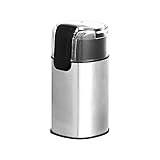
1. Amazon Basics Electric Coffee Grinder, Coffee Bean and Spice Grinder, With Heavy-Duty Stainless Steel Grind Blades
Overview:
This no-frills electric grinder tackles coffee beans, spices, and herbs with a basic push-button design. Its 10-second grind time for a single serving and transparent lid offer practical home use without advanced controls.
What Makes It Stand Out:
The standout feature is its simplicity and affordability. The heavy-duty stainless steel blades reliably handle small batches (30g), while the clear safety lid lets you monitor grind consistency visually—ideal for beginners avoiding over-processing.
Value for Money:
Priced accessibly, it delivers core functionality without extras. While lacking customization, it outperforms manual grinders in speed and rivals pricier models for basic drip-coffee needs, making it a smart budget buy for occasional users.
Strengths and Weaknesses:
Strengths: Quiet operation, easy cleanup, compact size, and versatile for spices/nuts. Weaknesses: No grind consistency control (only on/off), small capacity limits batch size, and plastic construction feels less durable than premium alternatives.
Bottom Line:
A reliable entry-level choice for those prioritizing cost and simplicity over precision. Best for drip-coffee drinkers needing quick, single-serve grinds without fuss.
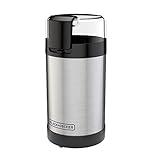
2. BLACK+DECKER One Touch Coffee Grinder, 2/3 Cup Coffee Bean Capacity, Spice Grinder, One Touch Push-Button Control -150 Watts -Stainless Steel Blades
Overview:
This 150W grinder combines user-friendly operation with safety-focused design. Its stainless steel bowl and blades target consistent results for coffee, spices, or grains, featuring intuitive one-touch control.
What Makes It Stand Out:
The lid-locking safety mechanism prevents operation unless secured—a rare feature in this segment—while the “30% better grinding” claim (via optimized RPM) delivers noticeably uniform results compared to basic models, enhancing flavor extraction.
Value for Money:
Mid-priced but punches above its weight with durable construction and safety extras. It justifies its cost over ultra-budget options by reducing waste from inconsistent grinds and offering longevity, especially for daily users.
Strengths and Weaknesses:
Strengths: Excellent safety lock, consistent coarse-to-fine control, sturdy stainless steel build, and spill-proof design. Weaknesses: Limited capacity (2/3 cup), no cord storage, and the push-button lacks pulse precision for espresso.
Bottom Line:
A secure, reliable workhorse for home baristas wanting consistent grinds without complexity. Highly recommended for safety-conscious users seeking durability under $30.
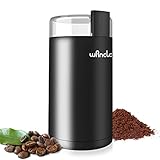
3. Wancle Electric Coffee Grinder, Spice Grinder, One Touch Coffee Mill for Beans, Spices and More, with Clean Brush Black
Overview:
Wancle’s grinder emphasizes aroma preservation via a pure copper motor and stainless steel components. Its one-touch operation and transparent lid cater to freshness-focused users grinding coffee, spices, or nuts up to 60g.
What Makes It Stand Out:
The pure copper motor reduces heat buildup during grinding—critical for preserving volatile coffee aromas—while the generous 60g capacity and included cleaning brush add practical value. The “finger-controlled” grind stop allows precise texture customization.
Value for Money:
Priced competitively, it offers premium thermal management often found in costlier grinders. The focus on flavor integrity justifies the investment for enthusiasts, though casual users might not leverage its full potential.
Strengths and Weaknesses:
Strengths: Superior heat control for fresher flavor, large capacity, versatile for multiple ingredients, and space-efficient design. Weaknesses: Motor noise is higher than average, plastic housing feels lightweight, and the lid seal can leak fine powders.
Bottom Line:
An aromatic standout for coffee purists who prioritize flavor over silence. Ideal for those grinding daily but verify counter space—it’s a worthy upgrade from basic models.
4. Bodum Bistro Electric Blade Coffee Grinder, Black

Overview:
Bodum’s sleek grinder targets style-conscious home brewers with its minimalist black design and 150W motor. It efficiently grinds beans for 8-cup French press batches using pulse or continuous modes.
What Makes It Stand Out:
Integrated cord storage in the base solves countertop clutter—a rarity in compact grinders—while the precise RPM blade ensures quick, even grinds. The transparent lid doubles as a measuring cup, blending form and function seamlessly.
Value for Money:
Priced mid-to-high, it excels in aesthetics and thoughtful details (like cord management) that justify the cost for design-focused users. It’s less about technical superiority and more about seamless kitchen integration.
Strengths and Weaknesses:
Strengths: Elegant footprint, convenient cord storage, consistent French press results, and pulse control for texture. Weaknesses: Small bean hopper, blades require careful cleaning, and lacks capacity for large batches (e.g., 12+ cups).
Bottom Line:
A stylish, space-smart solution for French press lovers valuing kitchen harmony. Buy if design matters as much as performance—but skip for high-volume needs.
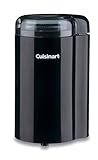
5. Cuisinart Coffee Grinder, One Touch Control Coffee Bean Grinder with Stainless Steel Bowl and Blades, 2.5 oz/70g Capacity Enough for 12 Cups, On/Off Switch with Safety Interlock, DCG-20BKN, Black
Overview:
Cuisinart’s high-capacity grinder handles up to 70g (12 cups) of beans with a robust motor and stainless steel components. Safety interlock and simple on/off controls cater to family-sized brewing.
What Makes It Stand Out:
The industry-leading 70g capacity sets it apart, enabling single-batch grinding for large pots. The 18-month warranty and safety interlock provide peace of mind, while the stainless steel bowl ensures longevity and easy cleaning.
Value for Money:
Despite a premium price, its large capacity reduces repeat grinding sessions, saving time for households. The warranty and durable build offer long-term value, outperforming cheaper models that struggle with volume.
Strengths and Weaknesses:
Strengths: Unmatched batch size, excellent warranty, consistent results, and included cord storage. Weaknesses: Bulky footprint, basic grind control (no pulse), and louder operation than competitors.
Bottom Line:
The top pick for families or frequent entertainers needing large, reliable grinds. Invest here if capacity and durability trump compact design.
6. Hamilton Beach Fresh Grind Electric Coffee Grinder for Beans, Spices and More, Stainless Steel Blades, Removable Chamber, Makes up to 12 Cups, Black

Overview: This compact electric grinder delivers versatile grinding for coffee beans, spices, and seeds, featuring stainless steel blades and a removable chamber. Ideal for daily coffee enthusiasts seeking freshness without complexity.
What Makes It Stand Out: Hidden cord storage reduces countertop clutter, while its quieter operation (vs. competitors) and dishwasher-safe bowl enhance convenience. The 12-cup capacity suits both single servings and full pots, and its multi-use design handles herbs and seeds effortlessly.
Value for Money: Priced accessibly, it outperforms basic single-serve grinders by offering larger batches and spice compatibility. Though lacking grind-size customization, its durability and easy cleanup justify the cost for casual users versus premium models.
Strengths and Weaknesses: Strengths: Space-saving cord storage; dishwasher-safe bowl; quiet for its class; versatile for coffee/spices. Weaknesses: No adjustable grind settings; manual stop required (no auto-shutoff); smaller capacity than some rivals.
Bottom Line: A reliable, budget-friendly grinder for simplicity seekers. Best for those prioritizing ease of use and cleanup over precision grinding—ideal for daily drip coffee lovers.
7. Hamilton Beach Custom Grind Electric Coffee Grinder for 4-14 Cups, One-Press Hand-Free Operation with Auto Shutoff, Removable Grinding Bowl For Easy Pour and Clean, Stainless Steel (80406)

Overview: Engineered for precision, this grinder features adjustable grind settings and hands-free operation, catering to espresso to French press enthusiasts. Its durable build supports versatile kitchen tasks beyond coffee.
What Makes It Stand Out: The adjustable selection ring lets users dial in exact grind sizes (4–14 cups), while one-press auto-shutoff ensures consistent results without monitoring. The removable stainless steel bowl simplifies pouring and dishwasher cleaning.
Value for Money: Mid-priced but punches above its weight with programmable precision absent in cheaper models. Competes well against pricier grinders by eliminating guesswork for specialty brews, offering long-term savings via reduced coffee waste.
Strengths and Weaknesses: Strengths: Customizable grind sizes; auto-shutoff for safety/consistency; spacious removable bowl; robust stainless steel construction. Weaknesses: Slightly louder than silent models; manual mode requires holding button; bulkier footprint.
Bottom Line: A top pick for coffee connoisseurs needing grind control. Worth the investment for espresso or pour-over fans seeking repeatable results and hands-free convenience.
8. SHARDOR Electric Super Silent Blade Coffee Grinder, Timed Grind Control Rotary Knob, Adjustable Coarse to Fine for Coffee Beans, Spices & Herbs, with 1 Removable Stainless Steel Bowl, Black

Overview: This whisper-quiet grinder (63 dB) uses a timed rotary knob for precise coarse-to-fine adjustments, targeting early risers and small-space dwellers. Its compact build handles coffee, spices, and grains efficiently.
What Makes It Stand Out: Industry-leading quiet operation ensures undisturbed mornings, while the intuitive timing knob (marked in seconds) delivers grind consistency. The removable 2.5oz bowl (10-cup capacity) and included cleaning brush enhance usability.
Value for Money: Budget-friendly with premium noise reduction. Though capacity lags behind larger models, its multi-functionality (spices, grains, herbs) and 2-year warranty offer exceptional utility for the price—outshining noisier rivals.
Strengths and Weaknesses: Strengths: Super-quiet (63 dB); precise timed control; versatile for dry ingredients; space-efficient; strong warranty. Weaknesses: Limited to 10 cups; no auto-shutoff; rotary knob requires manual timing accuracy.
Bottom Line: Perfect for apartment dwellers or noise-sensitive households. A smart buy for those valuing tranquility and simplicity over high-volume grinding.
9. SHARDOR Electric Super Silent Blade Coffee Grinder, Timed Grind Control Rotary Knob, Adjustable Coarse to Fine for Coffee Beans, Spices & Herbs, Black
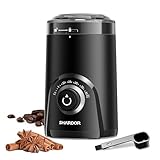
Overview: A sleek evolution of SHARDOR’s silent grinder, this model emphasizes ultra-compact design without sacrificing functionality. It targets travelers and minimalists needing quiet, multi-ingredient grinding in tight spaces.
What Makes It Stand Out: Combines 63 dB quietness with exceptional portability—fits in cabinets, bags, or RVs. The timed rotary knob ensures grind precision, while multi-use capability (spices, grains, rock sugar) replaces single-purpose tools, reducing clutter.
Value for Money: Slightly pricier than #8 due to refined ergonomics, but justifies cost through space-saving brilliance and travel readiness. Beats bulkier grinders for renters or adventurers where counter space is premium.
Strengths and Weaknesses: Strengths: Extremely compact and portable; near-silent operation; versatile for diverse dry ingredients; modern aesthetic; 2-year warranty. Weaknesses: Smaller capacity (10 cups); no auto-shutoff; timing knob less intuitive than dial systems.
Bottom Line: The ultimate space-saver for travelers or tiny kitchens. Choose this over #8 if portability and aesthetics are critical—ideal for fresh coffee on the go.
Understanding Blade Grinder Mechanics
How Blade Grinders Actually Work
Unlike burr grinders that crush beans between two abrasive surfaces, blade grinders rely on a single, rapidly spinning propeller-like blade. Beans are tossed violently against the blade and the chamber walls through centrifugal force. This action chops, slices, and smashes the beans indiscriminately. The speed of the motor and the duration of grinding determine the resulting particle size, but crucially, it lacks precision. There’s no mechanism to ensure uniformity; it’s a chaotic process where some beans get hit repeatedly while others escape relatively unscathed.
The Critical Role of Motor Power
Motor strength is a key differentiator among blade grinders marketed for speed. A more powerful motor (typically measured in watts) can spin the blade faster and maintain that speed even when the chamber is fuller. This translates to potentially quicker grinding times to reach a desired coarseness for the method you’re using. However, higher power also often means more noise and potentially more heat generation, which can negatively affect delicate coffee flavors if grinding for too long.
Why Blade Geometry Matters
The shape and sharpness of the blade significantly influence the grinding action. Sharper, strategically angled blades can make cleaner cuts initially, potentially yielding slightly better consistency in the short bursts needed for coarse grinds. Dull or poorly designed blades primarily smash the beans, creating excessive fines and generating more heat. Unfortunately, blade sharpness degrades over time with use, further diminishing performance without the user necessarily noticing immediately.
Evaluating Speed vs. Quality Trade-offs
The Illusion of “Quick Grinding”
While blade grinders can produce grounds fast, the critical question is: grounds suitable for what? Achieving a truly consistent grind size suitable for espresso or pour-over is virtually impossible, regardless of grinding time. For coarse methods like French press, a very short pulse (2-5 seconds) might yield acceptable results quickly, but extending the time for finer grinds almost guarantees a chaotic mix of particle sizes, negating the speed advantage by producing a poor brew.
Heat Buildup: The Silent Flavor Killer
The high-speed friction inherent in blade grinding generates significant heat. This heat can prematurely “cook” the coffee grounds during the grinding process, scorching delicate volatile compounds responsible for nuanced aromas and flavors. The longer you grind to chase a finer consistency, the hotter the grounds become, leading to a flat, stale, or burnt taste in your final cup – a direct consequence of prioritizing speed over thermal control.
Static and Mess: The Unavoidable Byproducts
The violent action inside a blade grinder creates substantial static electricity. This causes fine coffee particles to cling stubbornly to the inside of the grinding chamber, the lid, and even leap out when opened. The result is wasted coffee, a messy countertop, and grounds that don’t even make it into your brewer, further reducing the effective yield from your beans. Managing this static is an annoying but necessary part of the blade grinding process.
Key Features to Consider for Optimal Performance
Chamber Capacity and Design
Consider how much coffee you typically brew. A chamber that’s too large for single servings means beans bounce around inefficiently, leading to worse consistency. A chamber that’s too small requires multiple batches for larger pots, defeating the speed purpose. Look for chambers made of non-static materials (some plastics are better than others) and designs that minimize死角 where grounds can hide. A tapered shape often helps beans circulate better towards the blade.
Control Mechanisms: Pulse vs. Continuous
The ability to pulse grind is non-negotiable for blade grinders. Continuous grinding almost guarantees over-processing and excessive heat. Look for models with a responsive pulse button that gives you precise control over short bursts (1-3 seconds). Some offer variable speed settings, but even with variable speed, pulsing remains the only viable technique for achieving any semblance of control over the grind size.
Ease of Cleaning and Maintenance
Because blade grinders create so many fine particles and static cling, they require frequent cleaning to prevent old, stale coffee oils from rancidifying and tainting your next brew. Look for models where the chamber, lid, and blade assembly are easily removable and dishwasher safe (check manufacturer instructions). A design that minimizes nooks and crannies where fines can hide makes cleaning significantly less tedious and more effective.
Matching Grind Size to Your Brewing Method
Why Uniformity is Crucial (and Hard with Blades)
Different brewing methods demand specific, relatively uniform grind sizes for optimal extraction. Too fine, and water can’t flow properly (or over-extracts); too coarse, and water rushes through too quickly (under-extracting). Blade grinders inherently produce a wide spectrum of particle sizes. Understanding this limitation is vital – you’re aiming for the least bad inconsistency for your chosen brew method, not true uniformity.
Achieving Coarse Grinds for French Press or Cold Brew
Blade grinders perform least poorly when making coarse grinds. Use very short pulses (2-4 seconds total, in multiple quick bursts). The goal is to break the beans into small, irregular pieces without creating excessive powder. Stop well before the grounds look uniformly sized; the presence of some larger chunks is preferable to too many fines, which cause bitterness. Sifting is impractical, so precise pulsing is key.
Why Fine Grinds are Problematic
Attempting to achieve a fine grind (for espresso or stovetop Moka pot) with a blade grinder is generally futile and detrimental. The prolonged grinding time needed generates excessive heat, burns the coffee, and creates an overwhelming amount of superfine dust that clogs filters and leads to severe over-extraction and bitterness. The inconsistency means some grounds are dust while others remain far too large, guaranteeing an unbalanced, unpleasant cup. For fine grinds, a blade grinder is simply the wrong tool.
Practical Tips for Maximizing Blade Grinder Results
The Pulse Technique: Your Best Friend
Mastering short, controlled pulses is essential. Start with 1-2 second bursts. After each pulse, shake the grinder gently to redistribute the beans (this helps achieve slightly better consistency). Repeat only until you reach the approximate coarseness needed for your brew method, erring on the side of slightly too coarse. Over-pulsing is the fastest route to a muddy, bitter mess.
Managing Temperature for Better Flavor
Grind in short bursts with pauses in between to let the motor and chamber cool slightly. Grinding room-temperature beans (not straight from the freezer, which increases static and can damage blades) also helps minimize heat transfer. If your grinder feels hot to the touch, stop and let it cool down before continuing – hot grounds mean compromised flavor.
Containing the Static Chaos
To combat static cling and mess, try these tricks: lightly dampen a paper towel and wipe the inside of the grinding chamber just before adding beans (be extremely careful it’s not wet, just barely damp – water and coffee beans are enemies). Alternatively, add a single, clean coffee bean to the chamber before grinding; some find this reduces static. Always grind over your sink or a tray to catch escaping fines.
Long-Term Considerations and Limitations
Blade Dullness: An Inevitable Decline
Blade grinders don’t stay sharp. The constant impact with hard coffee beans gradually dulls the cutting edge. A dull blade smashes beans instead of cutting them, generating even more heat, fines, and inconsistency. While some blades can be removed and sharpened (rarely practical), most require full replacement or mean the grinder’s performance degrades significantly over time, often within a year or two of regular use.
Noise Levels: The Early Morning Reality Check
The high-speed motor and chaotic bean action make blade grinders notoriously loud – often significantly louder than burr grinders. If you’re grinding early in the morning in a shared household, this can be a major drawback. Consider the noise impact on yourself and others before committing to a blade grinder as your primary method.
When Speed Isn’t Worth the Sacrifice
Be brutally honest about your coffee priorities. If you genuinely care about tasting the origin characteristics, acidity, sweetness, or nuanced flavors of your coffee beans, the inconsistency of a blade grinder will be a constant barrier. The speed advantage might save 30 seconds, but it costs you the potential for a truly great cup. For espresso, pour-over, or AeroPress enthusiasts, a blade grinder is simply not a viable path to quality, regardless of how “quick” it is.
Frequently Asked Questions
Frequently Asked Questions
Can I use a blade grinder for spices or nuts? While technically possible, it’s strongly discouraged. Coffee oils will permeate the chamber and blade, ruining the flavor of your spices or nuts (and vice-versa). Dedicated grinders for each purpose are essential for taste integrity.
Why are my coffee grounds so inconsistent? Inconsistency is inherent to blade grinder design due to the random impact method. Shorter grinding times for coarser brews yield less inconsistency, but true uniformity is unattainable with this technology.
How often should I clean my blade grinder? Clean after every 3-5 uses, or immediately if you notice stale flavors. Residual oils become rancid quickly. Pay special attention to the chamber lid and the area under the blade where fines accumulate.
Can I sharpen the blade myself? It’s generally not recommended or practical. Blades are small, require precise angles, and improper sharpening can unbalance them, causing excessive vibration and noise. Replacement is usually the safer, more effective option.
Will a more expensive blade grinder give me better consistency? Marginally, perhaps, due to a more powerful motor or slightly better blade design, but the fundamental limitation of the blade grinding mechanism remains. Significant improvements in consistency require switching to a burr grinder.
Is it okay to grind pre-ground coffee in a blade grinder? No, this is ineffective and potentially dangerous. Pre-ground coffee is too fine and can overheat the motor instantly or create a huge static mess. Blade grinders are designed for whole beans only.
How do I know when the grind is “done” enough? For coarse methods (French press), stop when beans are broken into small, irregular pieces roughly the size of coarse sea salt, with minimal visible powder. Err on the side of coarser; you can always pulse more, but you can’t undo over-grinding.
Can blade grinders be used for Turkish coffee? Absolutely not. Turkish coffee requires an extremely fine, flour-like consistency that blade grinders cannot achieve without generating destructive heat and an unusable mix of powder and chunks. A dedicated Turkish grinder (usually a specialized burr type) is necessary.
Do blade grinders work well for single-serve coffee makers? Results are often poor. Single-serve systems (like certain pods or capsules) frequently require a specific, consistent medium-fine grind that blade grinders struggle to produce, leading to clogs or weak coffee. Check your maker’s recommendations first.
Is there any brewing method where blade grinders truly excel? Blade grinders are only reasonably suitable for very coarse grinds used in French press or cold brew, and even then, results are significantly inferior to a burr grinder. They offer speed for these methods but sacrifice quality and consistency. For any method requiring medium or fine grinds, they are not a good choice.
See Also
- 10 Essential Ceramic Burr Coffee Grinders Every Enthusiast Needs in 2026
- 10 Best Coffee Grinders After 6 Months of Testing in 2026
- 10 Most Durable Stainless Steel Coffee Grinders Based on Real User Reviews
- 2026’s Top 10 Conical Burr Grinders for Ultra-Precise Grinding
- The 10 Best Coffee Grinders Every First-Time Buyer Needs This Year